
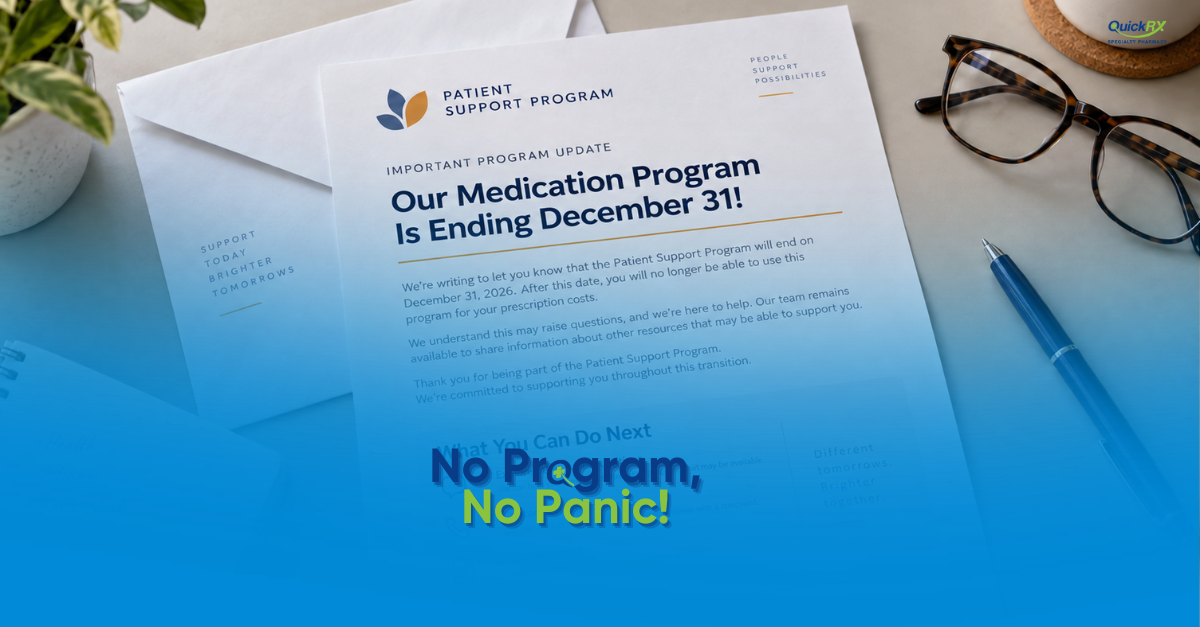
What to do when your manufacturer copay program is ending
We got a call today from a new patient. She had just opened a letter telling her that the manufacturer support keeping her prescription affordable would end at the end of the year. That night she went online searching for anything that would keep her medication within reach.
If you have opened a letter like that, you still have options, and you do not have to sort through them by yourself.
Why manufacturer copay programs end
Manufacturer copay programs end because they are voluntary offers, and the terms of the program state the conditions under which the manufacturer can change or discontinue them.
Your letter is the authority on your own situation. It should tell you what is changing and when. If it does not say clearly, the program administrator’s phone number is on the letter and on the program’s terms, and you can ask them directly.
If you have Medicare, Medicaid, TRICARE, or VA coverage: manufacturer copay cards have never been available to you. Federal anti-kickback rules prohibit manufacturers from subsidizing cost-sharing for federal health program beneficiaries. A closing copay program is not the door that just shut on you. Independent foundation grants are the path that was always yours, and many of those funds are open specifically to patients with Medicare.
What the letter actually means for your prescription
A letter ending a copay program changes what you pay, not whether you can get your medication.
Your prescription is still valid and nothing about your treatment has changed. What changes is the amount you are responsible for once the manufacturer stops covering part of it.
Look on your letter for the date the change takes effect. That date is what tells you how much time you have to put something else in place, and it matters more than anything else in the letter. Also look for whether the program is ending outright or changing its terms, and whether it names a replacement or a transition option. Keep the letter, because some assistance applications ask for proof that other coverage has ended.
“The letter is a billing change, not a clinical one. Nothing about your prescription or your treatment plan has changed. What has changed is the deadline you are now working against, so the first thing to look at is the effective date.”
Julia Kravtsova, PharmD, Head Patient Navigator, QuickRx Specialty Pharmacy
What options remain after a copay program closes
The most common paths after a manufacturer program ends are independent foundation grants, manufacturer patient assistance programs, and switching to a generic version of the medication if one exists.
Knowing the options exist is not the same as being able to use them, and this is where most people get stuck. Each foundation has its own application, its own income rules, and its own list of which diagnoses it covers. Most require documents you have to gather from your insurer and your prescriber. Some applications are online only. Some have to be submitted by the pharmacy rather than by you. Sorting through that while you are also worried about your next refill is a great deal to ask of anyone, and it is the reason people who qualify for help often never receive it.
Independent foundation grants
Independent charitable foundations run disease-specific funds that help with out-of-pocket costs, and unlike manufacturer copay cards, many of these funds are open to patients with Medicare.
These foundations are required to operate independently of the manufacturers that donate to them. The HHS Office of Inspector General’s 2014 Supplemental Special Advisory Bulletin sets out what that independence has to look like, which is why a foundation cannot steer you toward a particular manufacturer’s drug and cannot let a donor decide who gets funded.
These funds open and close according to their funding cycles, without notice. A fund can be open for a matter of minutes before its money is committed and it closes again. That is why calling once, hearing a fund is closed, and giving up is the most common reason patients who would have qualified end up with nothing.
QuickRx monitors these funds with alerts, so our navigators know the moment one reopens. When it does, they register patients right then, while the window is open. This is the part of the process that is nearly impossible to do on your own, because it requires watching continuously rather than checking when you happen to think of it.
“Patients call a foundation once, hear that the fund is closed, and stop there. These windows can last minutes, and there is no announcement when one opens. We watch for them so our patients do not have to, and we register them the moment the fund is live.”
Julia Kravtsova, PharmD, Head Patient Navigator, QuickRx Specialty Pharmacy
Manufacturer patient assistance programs
Manufacturer patient assistance programs are a separate thing from copay cards, and they provide medication at no cost to patients who meet income requirements.
Eligibility for these programs depends on your income and your health needs, and you apply directly to the drug company for the medication you are taking. They are generally aimed at people who are uninsured or underinsured. A manufacturer can end a copay card program while continuing to run a patient assistance program, so the letter you received does not necessarily mean the manufacturer has stopped helping altogether.
Generic versions
If a generic version of your medication is available, that alone may change your cost substantially.
A generic contains the same active medicine as the brand and is approved as safe and effective by the FDA, while costing less because the research and marketing costs behind the brand are not built into its price. There are cases where the brand matters for a particular patient, so ask your prescriber whether a generic is appropriate for you. Foundation grants generally cover generics, so the two paths can work together rather than being a choice between them.
What to do first
Start before the date on your letter, because assistance applications take time to process and approval is not immediate.
Have these ready:
- The letter itself, including the effective date
- Your current insurance card
- The name and dose of your medication
- Your prescriber’s name and phone number
Do not stop taking your medication or skip doses while you work this out. If cost is going to be a barrier, tell your prescriber so they can help you plan around it rather than finding out after a missed refill.
Free navigation review, no charge and no obligation
A QuickRx patient navigator will read the letter with you, identify which foundations and assistance you may qualify for, and complete the applications with you. If a fund is closed when you call, you go on our alert list and we register you when it reopens. You do not have to be a QuickRx patient to ask.
Why patients call QuickRx
QuickRx Specialty Pharmacy is URAC and ACHC accredited and licensed in all 50 states, so we can ship to you no matter where you live. Patients have left us 250 five-star reviews on Google.
Our patient navigators handle the part that takes the most time: watching for which foundations and assistance are currently open, checking what you qualify for, and completing the applications with you. The funding comes from independent foundations and grant organizations. There is no charge to you for the navigation.
If you received a letter and you are not sure what it means for you, start here or call (917) 830-2525.
Frequently asked questions
Copay programs are voluntary offers, and the terms of each program state the conditions under which the manufacturer can change or end it. Most send written notice before the change takes effect, which is the letter patients receive. Your letter and the program’s terms are the authority on your own situation.
No. >Federal anti-kickback rules prohibit manufacturers from subsidizing cost-sharing for people with Medicare, Medicaid, TRICARE, VA coverage, or other federal health programs. If you have federal coverage and your costs are changing, the cause is something else, and independent foundation grants are the path most often available to you.
No. A copay card reduces what an insured patient pays at the pharmacy. A patient assistance program provides medication at no cost to patients who meet income requirements and are typically uninsured or underinsured, and you apply directly to the drug company. A manufacturer can end one while continuing the other.
No. Foundation funds reopen as their funding allows, sometimes for only a few minutes, and there is no announcement when it happens. QuickRx monitors these funds with alerts and registers patients the moment a window opens. Call (917) 830-2525 to be added to our alert list.
No. QuickRx is a pharmacy, not a funding organization. Our navigators find the outside foundations and assistance you may qualify for and complete the applications with you. The funding comes from those independent organizations.
No. You can request a navigation review whether or not you currently fill with us. If you decide to transfer, we are licensed in all 50 states and can ship to you.
Timelines vary by foundation and by fund. Because approval is not immediate, start before the effective date on your letter rather than after your next refill is due.
Medical Disclaimer: This article is for general information only and is not medical advice. Eligibility for any assistance depends on your insurance, income, and the terms of the specific program. Program terms and fund availability change without notice. Do not stop or change how you take a prescribed medication without speaking to your prescriber.
References
- U.S. Department of Health and Human Services. Supplemental Special Advisory Bulletin: Independent Charity Patient Assistance Programs. Office of Inspector General, May 21, 2014.
- U.S. Department of Health and Human Services, Office of Inspector General. Special Advisory Bulletins.
- MedlinePlus, National Library of Medicine. How to save money on medicines.
Author: Paola Larrabure, Pharma Content Manager
Medically reviewed by: Julia Kravtsova, PharmD, Head Patient Navigator
Last Updated: September 10, 2026