
By Paola Larrabure, Pharma Content Manager
Last Updated: September 22, 2026
Medically reviewed by Julia Kravtsova, PharmD, Head Patient Navigator, QuickRx Specialty Pharmacy (LinkedIn).
Reviewed September 22, 2026.
It has been a year.
Three scalp massagers. One bottle of rosemary oil. Viviscal. Minoxidil. Name the thing and I have probably tried it, read the studies behind it, and kept a bottle of it in the cabinet long after I stopped believing in it.
The hair is still falling, and it is falling fast.
The part that surprised me is where. It went in the front. Which means that at 46 years old, after a career spent writing about medicine, I now rock a combover. I disguise it with a hair color powder I bought off TikTok Shop, and I am telling you that in print because I suspect a lot of you have the same little jar in your bathroom and have never said so out loud.
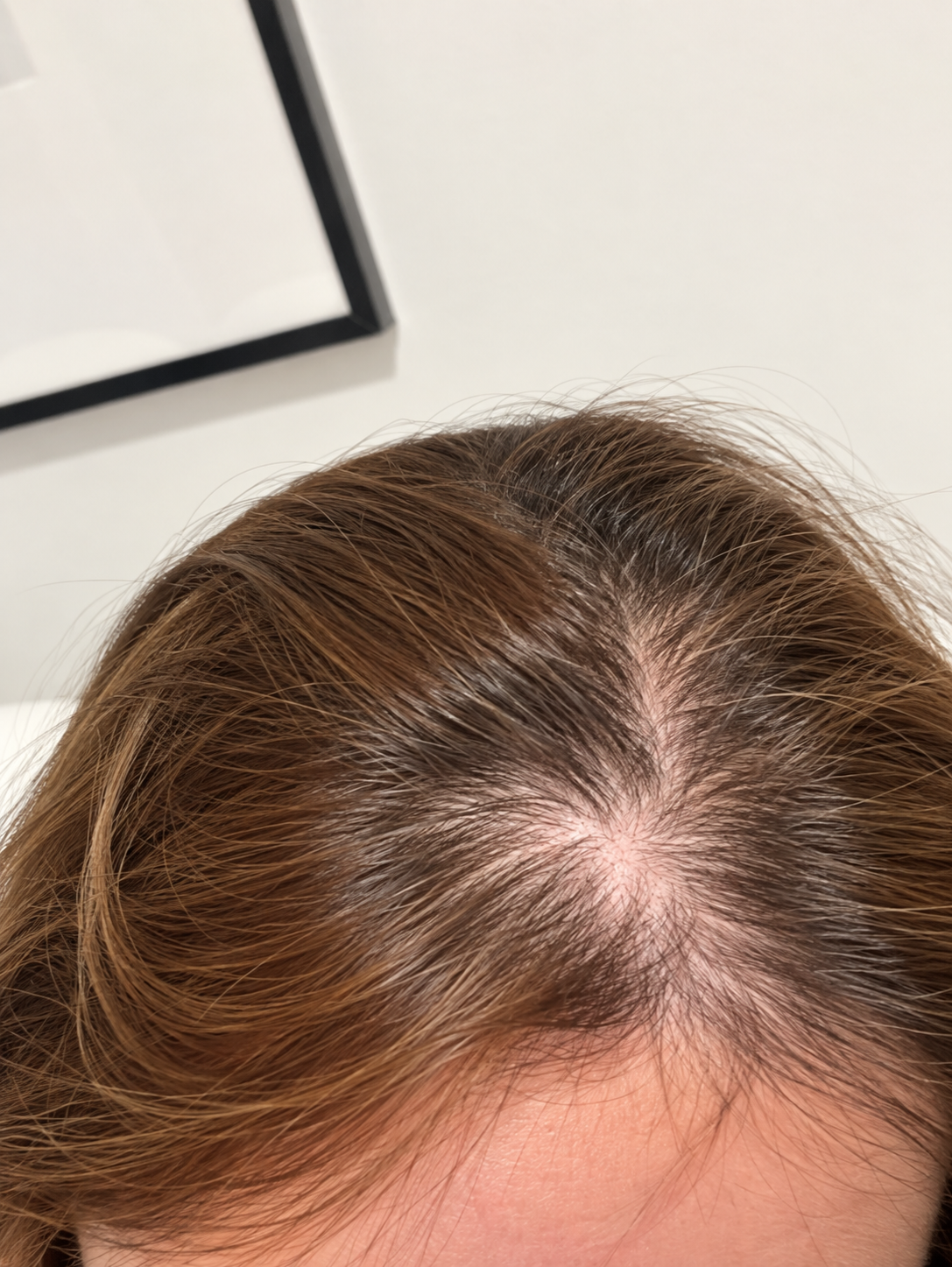
Hair thinning can become more noticeable around the part and crown, where increased scalp visibility may be easier to see.
The part the clinical literature never covers
I want to be honest about the insecurity, because the clinical literature never covers it. There is the pre-photo dread, where someone lifts a phone and your first thought is which way the light is coming from. There is the wind. There is the specific horror of a bathroom with overhead lighting. There is the mental arithmetic of whether you can wash your hair before an evening event or whether you need the powder to stay put. It is exhausting in a way that is separate from the medical part, and it wears on you every single day.
And then my annual labs came back.
When “normal” labs don’t tell the whole story
A result inside the reference range can still be worth looking at in context, especially when several tests show a consistent trend.
My hemoglobin was low. My hematocrit was low. Not dramatically, not in a way that sets off alarms, just quietly under the line where they used to sit comfortably.

Blood test results showing hemoglobin at 11.5 g/dL and hematocrit at 34.7%, both slightly below the laboratory reference ranges.
Meanwhile I could not get up in the morning. I was tossing in bed half the night and then dragging myself through the day. The brain fog was the worst of it, the kind where you read the same sentence three times and still could not tell anyone what it said.
So I did what most women my age do. I put it together myself and thought: perimenopause. Of course. Forty-six. Hair thinning, terrible sleep, fog, mood all over the place. It fits.
Another trip to my doctor’s office. More tests. Hormones came back in check.
Which left me somewhere worse than where I started, in the particular limbo a lot of women will recognize: the anxiety of thinking it is all in my head, while losing the hair on it.
I was very far from the only one. Somewhere around month eight I fell into the Reddit threads at one in the morning, and the pattern in them is almost eerie. Same symptom list, same age range, same sentence over and over: my doctor said everything was normal.
- r/beauty: “anyone here had extreme hair loss due to low ferritin or vitamin D?” Ferritin 57.4, vitamin D 31.3, hair falling out in clumps, told everything was fine.
- r/Anemic: “Can a ferritin level of 22 cause hair loss?” Two doctors, two opposite readings of the same number. One prescribed iron. One was not concerned.
- r/Anemic: “your doctor keeps telling you your labs are fine” A patient-run chart circulating widely, claiming anything under 100 counts as deficiency. Read the section below on thresholds before you take that one to heart.
The algorithm found it before my chart did
Ferritin is the protein that stores your body’s iron, and it is one of the primary laboratory measures clinicians use to assess your body’s iron stores.
TikTok started showing me ferritin deficiency videos. I do not know what I had searched to earn them, and I am aware of exactly how that sounds coming from someone who writes health content for a living. But there it was, over and over, the same list I had been carrying around for a year: hair loss, brain fog, insomnia, fatigue, anxiety.
So I pulled my own records. Months of bloodwork. Vitamin D, B12, thyroid panel, thyroid antibodies, a full metabolic panel, a cholesterol panel, hormones, even a colon cancer screening.
No ferritin. Not once. In a year of being tired, it had never been drawn.
I asked for it today.
What ferritin is, and why it is different from an iron test
Ferritin reflects stored iron, while serum iron measures the iron circulating in your blood at the time of the test.
Think of it as the difference between your bank balance and the cash in your wallet. You can have a perfectly reasonable amount of cash on you and almost nothing in savings. Your body works hard to keep the circulating number steady, and it does that by quietly draining the reserves first.
Your wallet and your savings account
Your body keeps the wallet full by quietly draining the savings
|
Cash in your wallet Hemoglobin The oxygen-carrying protein in red blood cells. This is commonly measured on a standard CBC. Still looks full |
Money in savings Ferritin The iron held in reserve. Usually not measured unless you ask. Nearly empty |
SAVINGS ⟶ WALLET
Iron stores can become depleted before hemoglobin falls, which is why ferritin may identify low iron stores before anemia appears on a CBC.
According to the National Institutes of Health Office of Dietary Supplements, iron depletion happens in stages. Storage iron drops first and ferritin falls with it. Next, the supply reaching your red blood cells declines while hemoglobin usually still reads normal. Only in the final stage do the stores run out, hemoglobin falls, and you become anemic.
| Stage | Ferritin (stored) | Hemoglobin | Standard panel says |
|---|---|---|---|
| 1. Stores deplete | Normal | ||
| 2. Supply to cells drops | Normal | ||
| 3. Anemia | Finally flagged |
Which means there can be a stretch of time when iron stores are running low while the numbers on a routine CBC still look normal.
Why normal bloodwork misses low iron stores
The measures most doctors use to screen for iron problems are hemoglobin and hematocrit, and the NIH describes them plainly as neither sensitive nor specific for this purpose.
“Neither sensitive nor specific”
What those two words mean for your blood test
Not sensitive: it misses people who do have a problem
Iron stores can fall substantially while hemoglobin remains within the normal range. That means hemoglobin alone may not identify earlier iron depletion, including in people who are already experiencing symptoms.
Not specific: when it does flag, it does not say why
Low hemoglobin has many possible causes besides iron. A flagged result tells you something is off without telling you what is behind it.
That sentence helps explain why those Reddit threads exist. Hemoglobin and hematocrit are included on standard blood counts. Ferritin usually is not. So a test that can help identify depleted iron stores before anemia develops may never have been ordered, while the routine blood-count measures can remain within range during earlier iron depletion.
This is not a conspiracy and it is not a bad doctor. It is a default panel doing what a default panel does. It just means that if you want ferritin, in most cases you have to ask for it by name.
Why ferritin thresholds depend on the clinical context
Ferritin cutoffs depend on the clinical context. The WHO uses below 15 ng/mL to define iron deficiency in apparently healthy adults, while some clinical guidelines use higher thresholds in specific patient populations.
The same number, three different thresholds
Where different sources decide your ferritin is too low
RLS-specific consensus guidance considers iron supplementation at or below this level.
Benefit from iron seen only below this level in the BMJ trial.
Built to identify depleted stores, not to predict symptoms.
The World Health Organization guideline on ferritin concentrations uses a cutoff below 15 µg/L to define iron deficiency in apparently healthy adults. Other guidelines use different cutoffs in specific clinical settings. For example, the American Gastroenterological Association recommends a cutoff below 45 ng/mL when using ferritin to diagnose iron deficiency in patients with anemia.
The complication is that several specialties work with much higher numbers when symptoms are involved. In sleep medicine the trigger is 75 ng/mL, as you will see below. In hair clinics you will commonly hear 30, 50, or 70 quoted as targets. Those higher figures come from clinical practice and expert consensus rather than from settled trial evidence, and they are the reason two doctors can look at a ferritin of 22 and reach opposite conclusions, exactly as that Reddit poster described.
Why inflammation can hide a low ferritin
One more thing worth knowing before you interpret your own result. Ferritin is an acute phase reactant, meaning inflammation pushes it up. A normal-looking ferritin drawn while you are fighting something off can mask low stores, which is why a full iron panel and an inflammatory marker in the same draw give a much clearer picture than ferritin on its own.
“Reference ranges are only one part of interpreting an iron result. The actual ferritin value, other iron studies, symptoms, and the patient’s clinical context all matter.”
Julia Kravtsova, PharmD, Head Patient Navigator, QuickRx Specialty Pharmacy
What the evidence actually says about ferritin and hair loss
Studies have often found lower ferritin levels in women with nonscarring hair loss, but the strength of the association varies, and whether raising ferritin reverses hair shedding remains uncertain.
I am going to give you both sides, because almost nothing else ranking for this question does, and because you deserve to know where the floor is solid and where it is not.
Supporting the link: a 2003 study in the Journal of Investigative Dermatology by Kantor and colleagues found decreased serum ferritin associated with alopecia in women. More recent work, including a 2025 case control study in Cureus, has again found significantly lower ferritin in women with telogen effluvium, the diffuse shedding pattern, compared with controls. Iron deficiency has been listed as a cause of telogen effluvium in dermatology textbooks for decades.
Against it: Bregy and Trüeb, publishing in Dermatology in 2008, found no association between ferritin above 10 µg/L and hair loss activity in women. Sinclair and colleagues reported no clear association between low ferritin and chronic diffuse telogen hair loss, and the small group of women they supplemented did not improve. A widely cited 2006 review by Trost, Bergfeld and Calogeras concluded there was insufficient evidence to recommend iron supplementation for women with hair loss and iron deficiency without anemia.
How strong is the evidence, symptom by symptom?
These are not equally supported, and the difference matters
| Symptom | Evidence | What exists |
|---|---|---|
| Restless legs and sleep | Strong | A clinical practice guideline directs testing and iron treatment |
| Fatigue and brain fog | Mixed | Randomized trials disagree; benefit concentrated at low levels |
| Hair loss | Contested | Association repeatedly observed; causation not established |
So where does that leave you?
So the honest summary is this. The association is real and it shows up repeatedly. The causation is unproven. Many dermatologists treat low ferritin in shedding patients anyway, on clinical judgment rather than on trial evidence, and they are open about that being what they are doing.
If you came here wanting someone to promise you that iron will regrow your hair, I cannot do that, and you should be suspicious of any page that does.
The symptom almost nobody connects to ferritin
Of all the symptoms on this list, the one with the strongest guideline backing behind an iron threshold is disrupted sleep, specifically restless legs.
This was the biggest surprise of my reading. The American Academy of Sleep Medicine clinical practice guideline on restless legs syndrome instructs clinicians to regularly test serum ferritin and transferrin saturation in patients with clinically significant symptoms, and it describes consensus guidance to supplement iron when serum ferritin is at or below 75 ng/mL, or transferrin saturation is under 20 percent.
Seventy-five, not fifteen
Seventy-five. Five times the number most labs use to flag a result as low.
Iron is a cofactor in dopamine production, which is the proposed mechanism, and the guideline notes that these iron thresholds are deliberately different from the ones used for the general population. It also recommends drawing the sample in the morning and avoiding iron-containing supplements and foods for at least 24 hours before the draw, which is a practical detail worth carrying into your appointment.
If you are lying awake with restless legs and someone has told you your iron is fine, this is the guideline to know about.
What about the exhaustion and the fog?
The evidence for iron improving fatigue in women who are low but not anemic is real, modest, and inconsistent.
The best known trial is Verdon and colleagues in the BMJ, a double blind randomized placebo controlled study of 144 non-anemic women aged 18 to 55. Fatigue dropped 29 percent in the iron group against 13 percent on placebo, and the effect was restricted to women whose ferritin was at or below 50 µg/L.
Later work complicated it. A trial using intravenous iron in non-anemic premenopausal women found the benefit only in those starting at or below 15 ng/mL. A larger trial in non-anemic blood donors found no difference against placebo at all.
Modest and real is still worth having when you have been this tired for this long. Just go in with accurate expectations rather than the ones the supplement ads are selling.
Why these symptoms get blamed on something else
Hair loss, fatigue, brain fog, poor sleep and mood changes belong to a long list of conditions, which is exactly why this takes so many women so long to sort out.
| Symptom | Iron deficiency | Thyroid disease | Low vitamin D | Perimenopause |
|---|---|---|---|---|
| Hair loss | ✓ | ✓ | ✓ | ✓ |
| Fatigue | ✓ | ✓ | ✓ | ✓ |
| Brain fog | ✓ | ✓ | ✓ | ✓ |
| Poor sleep | ✓ | ✓ | ○ | ✓ |
| Mood changes | ✓ | ✓ | ✓ | ✓ |
My own year is a decent case study. Every one of my symptoms is a textbook perimenopause symptom, so that is where I went first, and it was a reasonable place to go. Every one of them is also a thyroid symptom, which is why my thyroid was tested. Every one of them is a vitamin D deficiency symptom, and mine was genuinely low earlier this year. Every one is also, plainly, a symptom of stress and not sleeping.
More than one thing can be true at once
Here is the thing I had to sit with. More than one of these can be true at the same time. Finding a hormonal explanation does not rule out an iron one. A normal thyroid does not mean nothing is wrong. The sorting is slow and it is frustrating, and the temptation to conclude that you are simply making it up is enormous.
Your symptoms still deserve an explanation. If iron deficiency is part of the differential, ask your clinician whether ferritin and iron studies are appropriate.
Tests your clinician may consider
Depending on your symptoms, history and previous results, your clinician may consider ferritin alongside other iron measures rather than interpreting it on its own.
This is the list I brought to my own request:
| Ask for | Why |
|---|---|
| Ferritin | Stored iron. The one that is usually missing. |
| Serum iron, TIBC, transferrin saturation | These show whether iron is actually available for use, and transferrin saturation appears in the sleep medicine guideline alongside ferritin. |
| CRP or another inflammatory marker | Because inflammation can push ferritin up and hide a low store. |
| A CBC, if you have not had one recently | And if you have had several, bring them all. |
Two practical notes. Look at the actual result rather than only the normal or abnormal label, because interpretation depends on the value, the laboratory’s reference range, other iron measures and your clinical context. And bring previous results if you have them. A single result is a snapshot, while results over time can give your clinician useful context.
If your ferritin does come back low, the follow-up question matters as much as the result. New iron deficiency in an adult is worth understanding the cause of, and that is a conversation for your clinician rather than a supplement aisle.
Where I am right now
I do not have my answer yet, and I decided to publish this anyway.
My request went in today. I asked for ferritin, a full iron panel, an inflammatory marker, and I asked whether I could come in for the draw rather than waiting until December. I do not know what it will say. It is entirely possible that ferritin comes back fine and I am back to square one with a combover and a jar of powder from TikTok Shop.
But I spent a year treating the symptom. Massagers, oils, supplements, minoxidil, all of it aimed at my scalp, none of it aimed at whatever might be upstream of my scalp. If there is one thing worth taking from a year of that, it is this: when a symptom will not resolve, at some point the question stops being which product and starts being which test.
I will update this page when I know more.
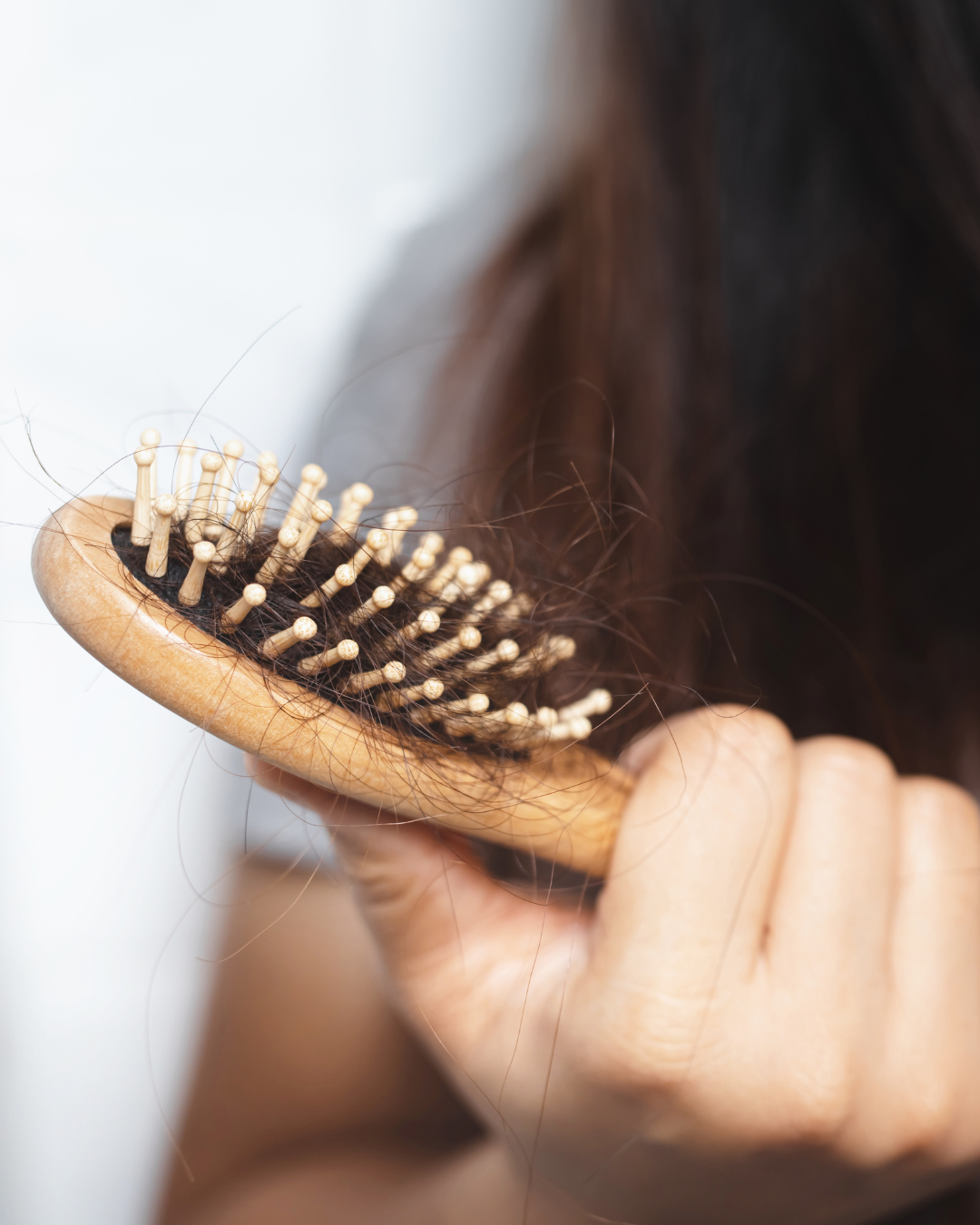
Daily shedding is the symptom most people notice first.
Frequently asked questions
Low ferritin is repeatedly found alongside diffuse hair shedding in women, and studies disagree on whether correcting it reverses the shedding. Several studies have found significantly lower ferritin in women with telogen effluvium than in controls, while others have found no association above 10 µg/L and no improvement with supplementation. Many dermatologists treat low ferritin in shedding patients on clinical judgment rather than on settled trial evidence.
Ferritin cutoffs depend on the clinical context. The World Health Organization uses below 15 µg/L to define iron deficiency in apparently healthy adults. Other guidelines use different thresholds in specific populations. For example, the American Gastroenterological Association recommends a cutoff below 45 ng/mL when diagnosing iron deficiency in patients with anemia, while restless legs syndrome has separate iron-treatment guidance.
Usually not. Standard panels typically include hemoglobin and hematocrit, which the NIH describes as neither sensitive nor specific for screening iron deficiency. Ferritin generally has to be requested by name.
Yes. The NIH describes iron depletion in stages, beginning with falling storage iron and ferritin while hemoglobin remains in the normal range. Anemia is the final stage rather than the first sign.
Low iron stores are strongly linked to restless legs syndrome, which disrupts sleep. The American Academy of Sleep Medicine guideline directs clinicians to test ferritin and transferrin saturation in patients with clinically significant restless legs, and describes consensus guidance to supplement iron at ferritin at or below 75 ng/mL or transferrin saturation under 20 percent.
The evidence is modest and mixed. A randomized placebo controlled trial of 144 non-anemic women found fatigue fell 29 percent on iron against 13 percent on placebo, with the benefit limited to women whose ferritin was at or below 50 µg/L. Other trials have found benefit only at much lower ferritin levels, and one in non-anemic blood donors found no benefit at all.
Ferritin is an acute phase reactant, so inflammation raises it. A result drawn during an inflammatory or infectious episode can read normal or high while iron stores are genuinely depleted, which is why a full iron panel and an inflammatory marker in the same draw give a clearer picture.
References
- National Institutes of Health, Office of Dietary Supplements. Iron: Fact Sheet for Health Professionals. ods.od.nih.gov
- World Health Organization. WHO guideline on use of ferritin concentrations to assess iron status in individuals and populations. Geneva: WHO; 2020. NCBI Bookshelf
- Winkelman JW, et al. Treatment of restless legs syndrome and periodic limb movement disorder: an American Academy of Sleep Medicine clinical practice guideline. J Clin Sleep Med. PubMed 39324694
- Verdon F, et al. Iron supplementation for unexplained fatigue in non-anaemic women: double blind randomised placebo controlled trial. BMJ. 2003;326(7399):1124. PubMed 12763985
- Kantor J, et al. Decreased serum ferritin is associated with alopecia in women. J Invest Dermatol. 2003;121(5):985-988. PubMed 14708588
- Bregy A, Trüeb RM. No association between serum ferritin levels >10 µg/l and hair loss activity in women. Dermatology. 2008;217(1):1-6. Karger
- Trost LB, Bergfeld WF, Calogeras E. The diagnosis and treatment of iron deficiency and its potential relationship to hair loss. J Am Acad Dermatol. 2006;54(5):824-844. JAAD
- Thamotharan N, et al. Assessment of Serum Ferritin Levels in Female Patients With Telogen Effluvium. Cureus. 2025. PMC12839778
A note on what this article is. This is a personal account alongside a review of published evidence. It is not medical advice, and it is not a diagnosis. Reference ranges vary between laboratories, and any result worth acting on is worth discussing with the clinician who ordered it.
QuickRx Specialty Pharmacy does not perform laboratory testing. If you have questions about a medication you are taking, our pharmacists are available at (917) 830-2525.