
Real Reddit Questions, Answered
Insurance and Billing
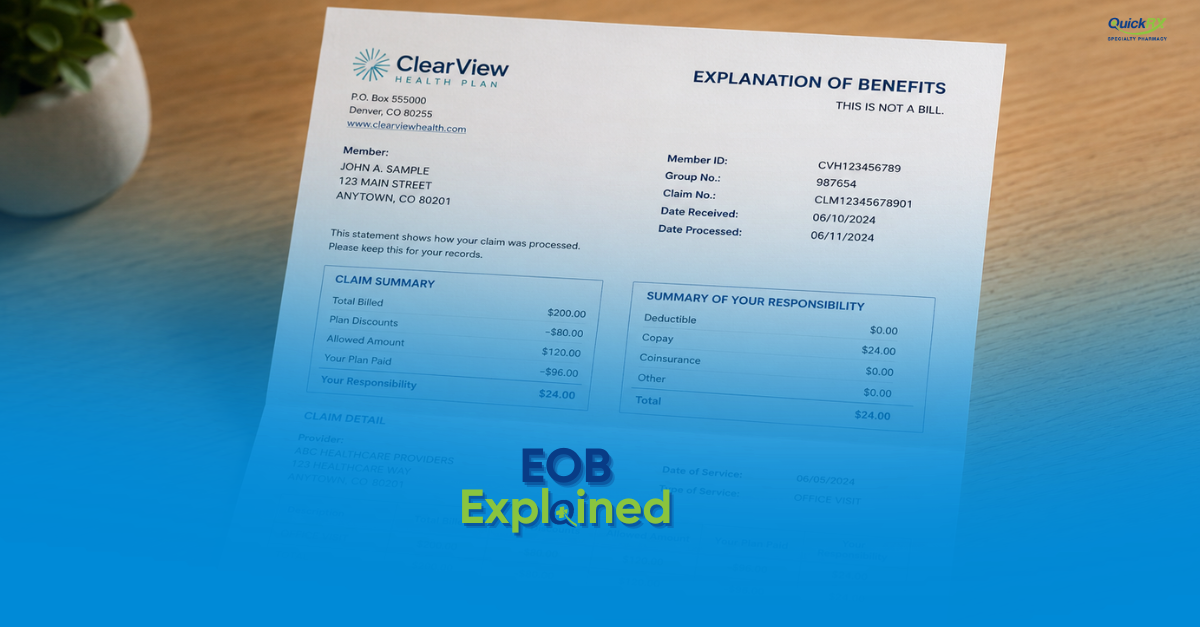
Few pieces of mail cause more confusion than an Explanation of Benefits. It arrives looking like a bill, it lists a scary balance, and then it says, in bold, that it is not a bill. Every week our team fields calls from patients who think QuickRx sent them a charge, when in fact we secured copay assistance and they owe us nothing. To answer this clearly, we pulled the most-asked EOB questions from Reddit and answered each one in plain language. The quotes below come from real posts on r/HealthInsurance, r/Insurance, r/personalfinance, and r/Adulting.
What is an Explanation of Benefits, and why does it say “This is not a bill”?
An Explanation of Benefits (EOB) is a summary your insurance sends after it processes a claim; it shows what was billed and what the plan paid, but it is not a request for payment, so you should never pay from it.
Reddit Question about Explanation Of Benefits
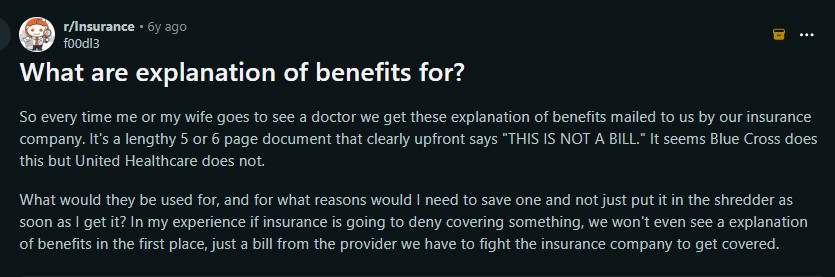
“So every time me or my wife goes to see a doctor we get these explanation of benefits mailed to us by our insurance company. It’s a lengthy 5 or 6 page document that clearly upfront says ‘THIS IS NOT A BILL.’ … What would they be used for, and for what reasons would I need to save one and not just put it in the shredder as soon as I get it?”
Think of the EOB as the receipt for a conversation between your provider and your insurer, not a conversation with you. Your provider files a claim, the insurer decides how much of it the plan covers, and the EOB reports the result: the total charge submitted, the amount the plan paid, any discount applied, and your estimated share. Because it is a status report and not a demand for money, it carries no payment stub and no due date. The actual request for payment comes later, and separately, from the provider.
When do you get an EOB: before or after the bill?
You usually get the EOB first, after your provider files the claim and before the provider’s bill arrives, so an EOB that shows a balance does not mean you owe that amount yet.
Question on Reddit about EOB timeframe
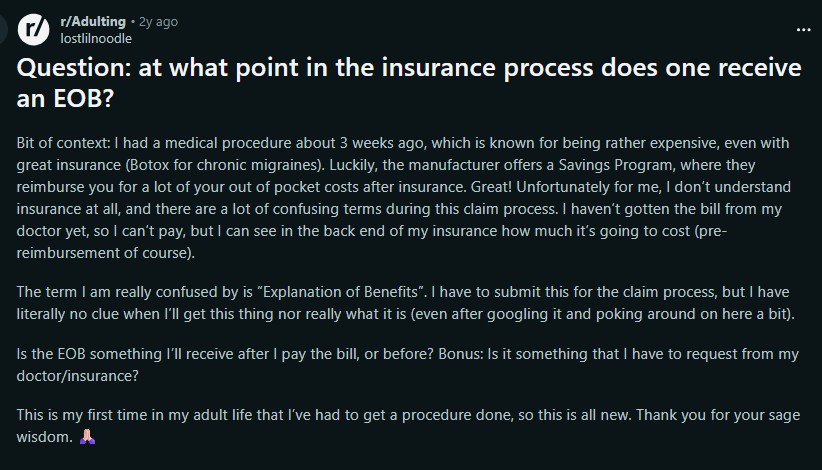
“The term I am really confused by is ‘Explanation of Benefits.’ … Is the EOB something I’ll receive after I pay the bill, or before? Bonus: Is it something that I have to request from my doctor/insurance?”
You do not have to request it. The EOB is generated automatically once your insurer finishes processing the claim, and it typically lands in your mailbox or member portal before the provider’s bill does. That timing is exactly why the EOB warns you not to pay from it: the number you see is the plan’s estimate of your share, and the provider still has to send its own statement. If you pay off an EOB balance early, you risk paying more than you actually owe.
Why is the amount on my EOB different from what my provider actually bills me?
The EOB shows the full billed charge minus the insurer’s negotiated network discount, and in-network providers must write off that discount, so your real bill is often lower than the balance shown on the EOB.
EOB vs Bill
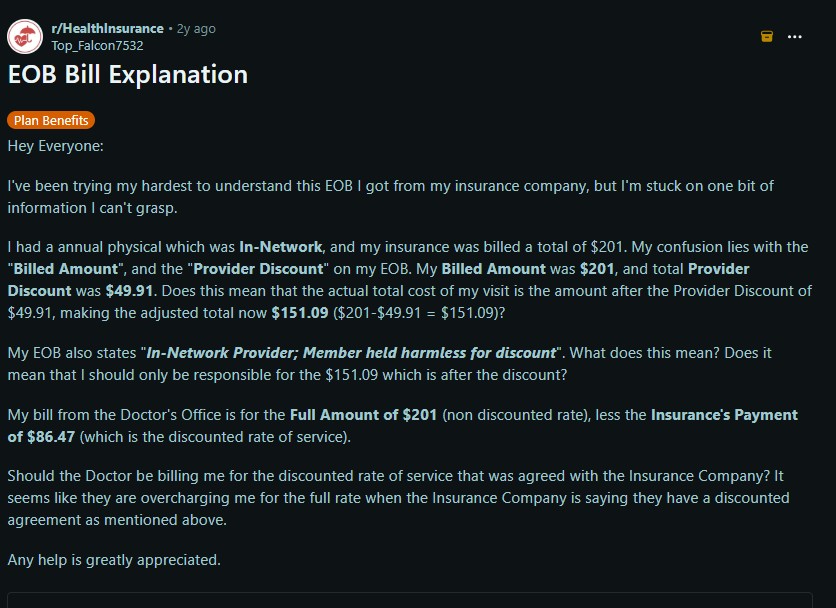
“My Billed Amount was $201, and total Provider Discount was $49.91. … My EOB also states ‘In-Network Provider; Member held harmless for discount.’ What does this mean? … Should the Doctor be billing me for the discounted rate of service that was agreed with the Insurance Company?”
“Member held harmless for discount” is good news for the patient. It means an in-network provider agreed to accept the insurer’s discounted rate as full payment and cannot bill you for the difference between the full charge and the discounted rate. So in that example, the provider writes off the $49.91 discount, and your share is calculated from the lower, agreed rate, not the $201 sticker price. This is also why the next poster saw a smaller bill than expected:
“I got a letter from my dental insurance saying that … my share of the charge is $982. … the dental office only made me pay $330 for that visit. … These discrepancies always make me concerned that I’m going to see a surprise bill in the future.”
A lower bill than the EOB is common and usually not a red flag. Providers sometimes apply contractual write-offs, courtesy adjustments, or in-office estimates that come in below the plan’s figure. The habit that protects you is simple: keep the EOB, compare it to the bill when it arrives, and question any bill that is higher than your EOB share rather than lower. If the provider ever bills you for the discounted portion on an in-network claim, that is the moment to push back.
Should I save my EOB, or shred it?
Save your EOB: it is your proof of what insurance paid, your tool for catching billing errors and surprise bills, and your documentation if you reimburse yourself from an HSA or FSA.
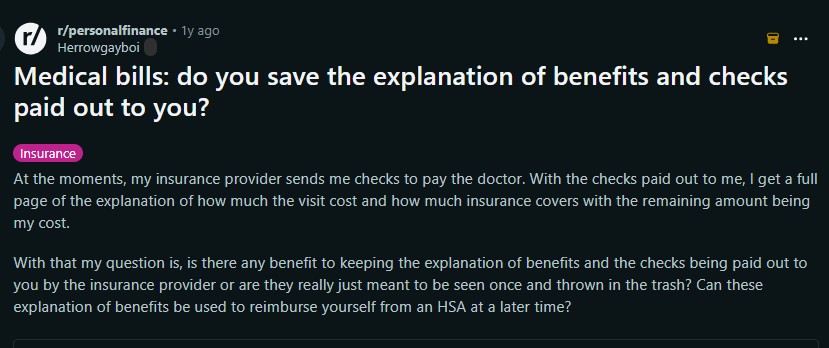
Question on reddit about keeping or throwing out your medical bills
“Is there any benefit to keeping the explanation of benefits and the checks being paid out to you by the insurance provider, or are they really just meant to be seen once and thrown in the trash? Can these explanation of benefits be used to reimburse yourself from an HSA at a later time?”
Do not shred it. An EOB earns its keep in three ways. First, it is your evidence: if a provider later bills you more than your share, the EOB is the document that proves it. Second, it is your error-catcher: comparing the EOB to the bill is how patients spot duplicate charges, services they never received, and claims applied to the wrong plan. Third, it is your paperwork trail for tax-advantaged accounts. When you reimburse yourself from an HSA or FSA, the EOB documents the amount you were responsible for, so keep it alongside the provider’s paid receipt. A practical rule is to hold EOBs until the matching bill is paid and reconciled, and to keep anything tied to an HSA reimbursement for your tax records.
What information does an EOB actually show?
An EOB lists the date of service, the provider, the service billed as a code or general description, the amount charged, the plan discount, what the plan paid, and your share; how much clinical detail appears varies by plan.
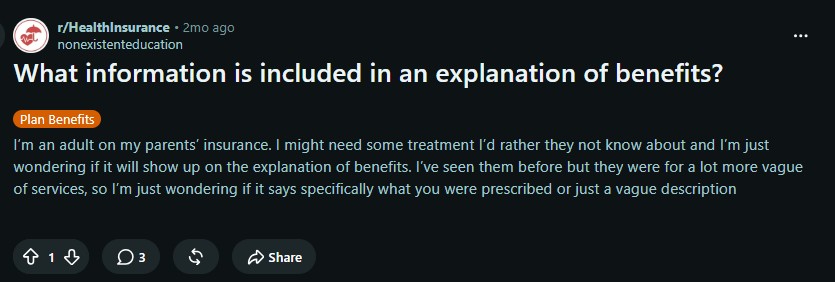
Reddit Question: Qhat information is included in an explanation of benefits
“I’m an adult on my parents’ insurance. I might need some treatment I’d rather they not know about and I’m just wondering if it will show up on the explanation of benefits. … I’m just wondering if it says specifically what you were prescribed or just a vague description.”
The level of detail is not the same on every EOB. Most show the date, the provider or facility, a service line described by a billing code or a general category, and the dollar figures. Some plans list a specific procedure or drug, while others show only a broad description. Because the EOB goes to the policyholder, a dependent on a parent’s or spouse’s plan should assume the primary subscriber can see at least a general record of the visit. If privacy matters to you, the reliable step is to ask your specific plan what its EOBs display, rather than assuming they are always vague. This is general information and not legal or medical advice about your particular plan.
Why did I pay less than my Explanation of Benefits says I owe?
Your EOB reflects only what your primary insurance processed, so if you paid less than the balance it shows, a form of copay assistance was likely applied after your primary insurance, lowering your final out-of-pocket cost.
An EOB is generated by your primary insurance, and it shows only what that plan saw: the billed charge, the plan’s discount, what the plan paid, and the share it calculated for you. It does not capture anything that happens after the primary claim is processed.
Copay assistance is one of those things that happens after. Programs such as manufacturer copay cards and foundation grants are applied on top of your primary insurance, once the plan has done its part. Because that support is applied later, it does not appear on the primary EOB. That is why the number on your EOB can look higher than what you actually paid.
If the amount you paid is lower than your EOB share, that is usually a good sign, not an error. When in doubt, compare your EOB to the actual receipt or statement for what you paid, and keep both together in case you need them later.
Frequently asked questions
No. An EOB is a summary your insurance sends after it processes a claim. It shows what was billed, what the plan paid, and your estimated share, but it is not a request for payment. You pay only when your provider sends an actual bill.
Not automatically. The balance on an EOB is an estimate of your share. Wait for the provider’s bill and compare it to the EOB before paying, because the final amount is often lower.
An in-network provider agrees to write off the insurer’s network discount, so you are not billed for that discounted portion. Your real bill reflects the discounted rate, which is usually less than the balance shown on the EOB.
Keep them. An EOB is your proof of what insurance paid, your tool for catching billing errors and surprise bills, and your documentation if you need to appeal a claim.
Yes. An EOB documents the amount you were responsible for, so it is useful supporting paperwork when you reimburse yourself from an HSA or FSA. Keep it with the provider’s paid receipt.
Your EOB reflects only your primary insurance. If you paid less than it shows, a form of copay assistance, such as a manufacturer copay card or a foundation grant, was likely applied after your primary insurance processed the claim, which lowered your final cost.
An EOB lists the date, provider, and service using a billing code or a general description, plus the amounts. How much clinical detail appears varies by plan; some show a general category rather than a specific drug or diagnosis.
References
- MedlinePlus, U.S. National Library of Medicine, health insurance and managing care resources: medlineplus.gov/healthinsurance.html.
- U.S. Department of Health and Human Services, Office of Inspector General, consumer resources on medical billing and fraud: oig.hhs.gov.
This article is general information about insurance documents and billing. It is not medical, legal, or financial advice. For questions about your specific plan, contact your insurer, and for questions about a QuickRx prescription, call (917) 830-2525.