
⚠️ Medical Disclaimer: This article is for educational purposes only and is not a substitute for professional medical advice, diagnosis, or treatment. Always consult your pulmonologist or healthcare provider before making any changes to your treatment plan. Clinical information sourced from: Richeldi L, et al. Efficacy and Safety of Nintedanib in Idiopathic Pulmonary Fibrosis. N Engl J Med. 2014;370(22):2071–2082; Nintedanib (OFEV®) Prescribing Information. Boehringer Ingelheim Pharmaceuticals, Inc.; Pulmonary Fibrosis Foundation Nintedanib Fact Sheet.
Key Takeaways
- OFEV (nintedanib) slows lung function decline by approximately 50% compared to placebo in the landmark INPULSIS clinical trials
- It does not cure IPF or reverse existing scarring — its goal is to slow the progression of fibrosis and protect the lung function you have
- Diarrhea is the most common side effect, reported in up to 62% of patients in clinical trials — but many patients manage it successfully with dietary strategies and medication
- Taking OFEV with food and a full glass of water — and eating a protein-rich meal beforehand — can significantly reduce gastrointestinal side effects
- Smoking lowers your blood levels of nintedanib, reducing how well it works — quitting before and during treatment is strongly recommended
- OFEV costs over $13,000 per month without assistance — but most patients pay little or nothing with the right copay program in place
- QuickRx provides free OFEV copay assistance — call (917) 830-2525
Quick Navigation
A pulmonary fibrosis diagnosis changes everything. Questions flood in — about the disease, about treatment, about what comes next — and a 15-minute appointment rarely leaves enough time to answer all of them. That is why so many IPF patients and their caregivers have found community in places like r/pulmonaryfibrosis on Reddit, where they share their real experiences, fears, and hard-won wisdom.
We read through the threads so you don’t have to. Below, we’ve compiled some of the most common real questions being asked about OFEV (nintedanib) — and answered each one using only clinically verified information.
“IPF patients come to us with so many questions — especially about side effects, how OFEV fits into their daily life, and whether they can actually afford it. At QuickRx, our job is to make sure they never have to stop treatment because of cost, and that they always have someone to call when they’re scared or confused. That’s what we’re here for.”
— Julia Kravtsova, PharmD, Head Patient Navigator at QuickRx Specialty Pharmacy
OFEV (Nintedanib) — Quick Overview
- Brand name: OFEV
- Generic name: Nintedanib
- Drug class: Tyrosine Kinase Inhibitor / Antifibrotic Agent
- FDA Approved: October 15, 2014
- Approved uses: Idiopathic pulmonary fibrosis (IPF); chronic fibrosing interstitial lung diseases (ILDs) with a progressive phenotype; systemic sclerosis-associated interstitial lung disease (SSc-ILD)
- Standard dose: 150 mg twice daily, approximately 12 hours apart, with food
- Available through: Specialty pharmacy only

“OFEV or Esbriet? My mom was recently diagnosed with PF. What are the pros and cons of each? Is one known to work better?”
Asked by a deleted user on r/pulmonaryfibrosis
This is one of the first questions almost every newly diagnosed IPF patient or caregiver asks — and it is a great one.
Both OFEV (nintedanib) and Esbriet (pirfenidone) are FDA-approved antifibrotic medications for IPF, approved on the same day in October 2014. Both work to slow the progression of lung scarring, and both are considered effective first-line options. Neither cures IPF or reverses existing damage — their shared goal is to protect the lung function you have for as long as possible.
This article focuses on OFEV, but it is worth briefly understanding how the two medications differ so that you and your doctor can make the most informed decision together.
How OFEV works: According to the prescribing information, nintedanib is a tyrosine kinase inhibitor that blocks multiple signaling pathways involved in fibrosis — specifically the VEGF, FGF, and PDGF receptors. By interfering with these pathways, it slows the ability of lung cells to produce scar tissue. The landmark INPULSIS clinical trials demonstrated that nintedanib reduced the annual rate of FVC (lung capacity) decline by approximately 50% compared to placebo — a meaningful result for a disease that currently has no cure.
The main practical differences patients and caregivers report: OFEV is taken twice daily with food, while Esbriet requires three doses per day. OFEV’s most commonly reported side effects are gastrointestinal — primarily diarrhea — while Esbriet is more associated with sun sensitivity, nausea, and fatigue. OFEV also has the broader FDA approval of the two, covering not just IPF but other progressive fibrosing ILDs and SSc-ILD.
Ultimately, neither medication is universally “better.” Some patients tolerate one far better than the other, and switching between them is always an option if side effects become unmanageable. Your pulmonologist — ideally one at an ILD center of excellence — is the right person to guide that decision based on your mother’s full medical history.

“Has anyone had dizziness on OFEV?”
Asked by u/cestmoififi on r/pulmonaryfibrosis
Yes — and you are not alone in noticing it.
While diarrhea is the most frequently reported side effect of OFEV, dizziness and headache are also documented in the prescribing information, occurring in more than 5% of patients in clinical trials. According to the FDA prescribing information for OFEV, the most common adverse reactions (greater than 5% incidence) include diarrhea, nausea, abdominal pain, vomiting, liver enzyme elevation, decreased appetite, headache, weight loss, and hypertension — and hypertension itself can contribute to dizziness and headache symptoms.
Patients in community forums have also reported that OFEV can worsen pre-existing blood pressure issues, which may be a contributing factor to dizziness. If you are experiencing dizziness while on OFEV, the most important step is to contact your prescribing pulmonologist and describe when it occurs — whether it is positional (upon standing), constant, or associated with other symptoms.
🚨 Seek Immediate Medical Attention If Dizziness Is Accompanied By:
- Chest pain or pressure
- Sudden numbness or weakness on one side of the body
- Trouble speaking or sudden severe headache
- Shortness of breath that is significantly worse than your baseline
- Fainting or loss of consciousness
These may be signs of a serious cardiovascular event requiring emergency care. Call 911 immediately.
Do not stop or reduce your OFEV dose on your own without speaking to your doctor first. According to the prescribing information, dose reductions and interruptions are managed according to specific clinical protocols — and abruptly stopping an antifibrotic has been shown in real-world studies to accelerate lung function decline.

“Did anyone have good experiences with OFEV?”
Asked by a deleted user on r/pulmonaryfibrosis
This question matters just as much as the ones about side effects — and the answer is yes, many patients do well on OFEV.
The clinical data supports cautious optimism. The landmark INPULSIS-1 and INPULSIS-2 trials — two large, randomized, placebo-controlled studies published in the New England Journal of Medicine — showed that nintedanib reduced the annual rate of FVC decline from approximately 240 ml/year in the placebo group to approximately 115 ml/year in the nintedanib group. That is roughly half the rate of lung function loss — a meaningful result for a disease that currently has no cure. Notably, INPULSIS-2 also demonstrated a significant reduction in the risk of acute exacerbations compared to placebo.
Long-term extension data has shown that nintedanib continues to slow disease progression for up to three years, and a combined analysis of clinical trial data shows a trend toward reduced mortality. It is not a cure — but for many patients, it has meaningfully extended a period of stability.
Beyond the numbers, real patient experiences reflect that spectrum. Some patients report managing OFEV with minimal disruption to their daily lives — particularly those who take it consistently with food, stay well hydrated, and work closely with their care team to manage any side effects early. Others have found the gastrointestinal side effects difficult to tolerate and have switched to Esbriet or explored dose reduction. Both paths are valid, and neither means the medication “failed” — it means treatment is being tailored to the individual.
What patients in the community have found helpful for managing OFEV side effects:
- Take OFEV with a full meal, not a snack. The prescribing information states that food significantly improves the drug’s absorption and tolerability.
- Eat a protein-rich meal before taking your dose. Patients in IPF community forums have reported that higher protein intake — eggs, chicken, Greek yogurt — before doses noticeably reduced diarrhea and nausea symptoms.
- Stay well hydrated. Consistent fluid intake throughout the day supports GI tolerance.
- Ask your doctor about loperamide (Imodium). The prescribing information specifically mentions antidiarrheal medication as a management strategy. Some patients carry it with them daily as a precaution.
- Check for fructose intolerance. Patients in IPF forums have found that discovering an underlying fructose intolerance — and adjusting their diet accordingly — dramatically improved their quality of life while on OFEV.
- Quit smoking if you haven’t already. Smoking has been shown to lower blood levels of nintedanib, reducing how effectively the medication works. The prescribing information recommends stopping before and during treatment.
“I always tell patients that the first few weeks on OFEV can be the hardest adjustment period, but that many people find a rhythm that works. Eating a real meal — not just a cracker — before each dose, staying hydrated, and keeping us in the loop if something feels wrong makes a real difference. You don’t have to white-knuckle through side effects alone.”
— Julia Kravtsova, PharmD, Head Patient Navigator at QuickRx Specialty Pharmacy
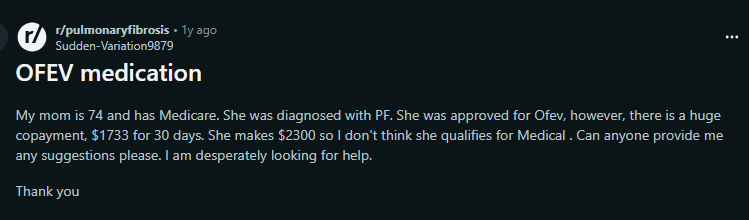
“My mom is 74 and has Medicare. She was diagnosed with PF and approved for OFEV — but the copay is $1,733 for 30 days. She makes $2,300/month. I’m desperately looking for help.”
Asked by u/Sudden-Variation9879 on r/pulmonaryfibrosis
First — the situation you’re describing is real, it is not your fault, and there are options. A $1,733 monthly copay on a $2,300/month income is not manageable, and you should not have to choose between your mother’s treatment and her basic needs. Here is what you need to know: What you may not know is that there are financial assistance options available for Medicare patients — and navigating them is exactly what QuickRx patient navigators do every single day.
OFEV’s manufacturer copay card is available only to commercially insured patients, which means Medicare patients are excluded by federal regulation. That gap is real, and it leaves families like yours in an incredibly difficult position. But it does not mean treatment is out of reach. At QuickRx Specialty Pharmacy, our patient navigators review your mother’s specific insurance coverage, income, and situation to identify every financial assistance program she may qualify for — manufacturer programs, foundation grants, Medicare subsidy options, and generic nintedanib savings — all at absolutely no cost to your family.
We handle the paperwork, make the calls, and keep you updated every step of the way. You should not have to spend hours researching assistance programs while also caring for a loved one with IPF. That is our job. Call QuickRx today: (917) 830-2525 — or visit our OFEV copay assistance page to get started. We will find a way to make this medication affordable for your mother.
💚 Struggling with the Cost of OFEV? We Can Help.
💚 Struggling with the Cost of OFEV? We Can Help.
OFEV is only available through specialty pharmacies — and at over $13,000 per month without assistance, cost should never be the reason a patient stops treatment. QuickRx Specialty Pharmacy provides completely free OFEV copay assistance to help make treatment accessible and affordable:
- Manufacturer copay card enrollment for commercially insured patients
- Patient assistance program applications for uninsured or underinsured patients
- Foundation grant applications for Medicare patients and those with financial hardship
- Generic nintedanib evaluation — we compare all available options for your situation
- Insurance navigation, prior authorization, and appeals support
- Nationwide home delivery — licensed in all 50 states
Our patient navigators handle all financial assistance paperwork so you can focus on treatment, not paperwork.
Call QuickRx today: (917) 830-2525
Author: Paola Larrabure, Pharma Content Manager at QuickRx Specialty Pharmacy
Medically Reviewed by: Julia Kravtsova, PharmD, Head Patient Navigator at QuickRx Specialty Pharmacy
Last Updated: April 2026
References
- Richeldi L, du Bois RM, Raghu G, et al; INPULSIS Trial Investigators. Efficacy and safety of nintedanib in idiopathic pulmonary fibrosis. N Engl J Med. 2014;370(22):2071–2082. PubMed 24836310
- OFEV (nintedanib) [prescribing information]. Ridgefield, CT: Boehringer Ingelheim Pharmaceuticals, Inc.
- Pulmonary Fibrosis Foundation. Nintedanib (OFEV®) Fact Sheet. pulmonaryfibrosis.org
- Kolb M, Richeldi L, Behr J, et al. Nintedanib in patients with idiopathic pulmonary fibrosis and preserved lung volume. Thorax. 2017;72(4):340–346. PubMed 27650330
- American Lung Association. Pulmonary Fibrosis Medications. lung.org
- Reddit r/pulmonaryfibrosis community threads: OFEV or Esbriet | Dizziness on OFEV | Good experiences with OFEV | OFEV Medicare copay
Comprehensive Medical Disclaimer: This article is published by QuickRx Specialty Pharmacy for educational and informational purposes only. It is not intended to be a substitute for professional medical advice, diagnosis, or treatment. Always seek the advice of your physician or other qualified healthcare provider with any questions you may have regarding a medical condition or medication. Never disregard professional medical advice or delay in seeking it because of something you have read in this article. QuickRx Specialty Pharmacy does not recommend or endorse any specific tests, physicians, products, procedures, opinions, or other information that may be mentioned in this article.
HIPAA Notice: QuickRx Specialty Pharmacy is committed to protecting your privacy. All patient information is handled in accordance with HIPAA regulations.
OFEV® is a registered trademark of Boehringer Ingelheim Pharmaceuticals, Inc. QuickRx Specialty Pharmacy is not affiliated with Boehringer Ingelheim Pharmaceuticals, Inc.